
A new client approaches a law firm to assist with a property purchase, a business acquisition or the establishment of a company. The documents appear complete, and the client is ready to proceed. But does the firm know who is ultimately behind the transaction and whether there are risks that deserve closer attention?
For legal professionals in Malaysia, AML compliance is not simply a matter of collecting identification documents. It involves understanding clients, the purpose of their instructions and the risks associated with the services being provided.
Effective AML compliance for law firms begins with a structured approach to client acceptance. By identifying potential concerns early, lawyers can protect their practice while fulfilling their professional responsibilities.
Why AML Compliance for Law Firms Matters in Malaysia
Lawyers are trusted to handle sensitive information, prepare legal documents and facilitate important commercial transactions. These responsibilities can also expose legal practices to attempts to disguise the ownership or origin of unlawful funds.
Malaysia’s Anti-Money Laundering, Anti-Terrorism Financing and Proceeds of Unlawful Activities Act 2001 (AMLA) establishes obligations for reporting institutions, including legal professionals carrying out specified activities.
Examples of relevant legal services include:
- Buying and selling real estate or business entities.
- Managing client funds, securities or other assets.
- Managing bank, savings or securities accounts.
- Organising contributions for the establishment or operation of companies.
- Creating, operating or managing legal entities or arrangements.
Not every legal instruction attracts identical AML obligations. Firms should assess the nature of each engagement and the applicable legal requirements.
The Malaysian Bar’s May 2026 reminder on strengthening AML compliance highlights the importance of reviewing internal controls following the AMLA amendments that took effect on 1 March 2026.
For the regulatory framework, firms can refer to Bank Negara Malaysia’s AML/CFT/CPF and Targeted Financial Sanctions policy document for DNFBPs and NBFIs.
Why Client Identification Alone Is Not Enough
An identity document helps establish who a client claims to be, but it may not reveal the wider risks associated with that person or their business relationships.
A client may provide a valid identity card while having undisclosed connections to a sanctioned entity. A company may be properly registered while its ultimate ownership remains unclear.
Legal practices should distinguish between three related processes:
| Process | Purpose |
|---|---|
| Identity Verification | Establish and verify the client’s identity. |
| Customer Due Diligence (CDD) | Understand the client, relevant ownership, engagement purpose and associated risks. |
| Client Risk Screening | Identify potential sanctions, watchlist, PEP and adverse media findings. |
Each process serves a different purpose. Screening complements due diligence rather than replacing it, and a clear screening result does not establish that a transaction is legitimate.
5 Client Red Flags Law Firms Should Recognise
The following examples illustrate situations where further enquiries or escalation may be appropriate. They are warning signs, not findings of wrongdoing.
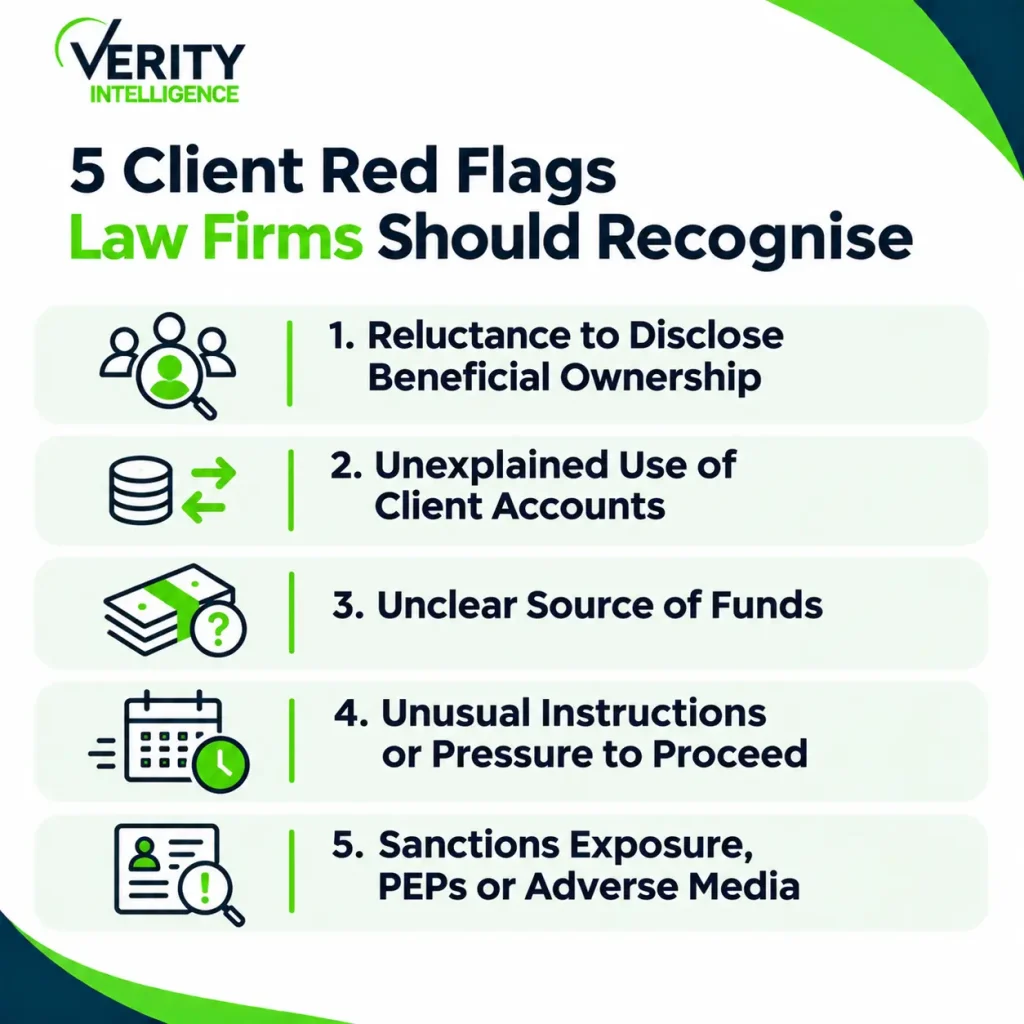
1. Reluctance to Disclose Beneficial Ownership
A corporate client may provide company registration documents but repeatedly avoid explaining who ultimately owns or controls the business.
Example: A lawyer receives instructions to prepare documents for an acquisition involving several corporate shareholders. The client’s representative cannot explain who exercises ultimate control.
What to do: Obtain relevant ownership information, verify it through suitable sources and resolve discrepancies before proceeding, where required. A registered shareholder is not necessarily the ultimate beneficial owner.
2. Unexplained Use of Client Accounts
Law firms may hold client money in connection with legitimate legal services. Concerns arise when a client requests transfers that have no clear relationship to the legal work being performed.
Example: A client requests that the firm receive funds and forward them to an unrelated business, without providing a convincing explanation of the connection to the engagement.
What to do: Establish the purpose of the payment, the parties involved and whether the activity is consistent with applicable client account rules and AML requirements. Escalate unexplained requests internally.
3. Unclear Source of Funds
A high-value transaction may deserve closer review when the funding arrangements are inconsistent with the client’s known financial or commercial circumstances.
Example: During a property purchase, the buyer proposes paying through multiple unrelated third parties and cannot explain their involvement.
What to do: Obtain appropriate information about the funding arrangements and, where required, supporting evidence of the source of funds or wealth. Consider the overall risk rather than treating the transaction value alone as suspicious.
4. Unusual Instructions or Pressure to Proceed
Urgency is common in legal work, particularly when commercial deadlines are involved. However, pressure to bypass ordinary verification procedures can be a warning sign.
Example: A new client insists on completing a corporate transaction immediately but refuses to provide information needed for the firm’s onboarding checks.
What to do: Explain the necessary procedures, document the circumstances and refer unresolved issues to the appropriate person within the firm. Commercial pressure should not override required compliance measures.
5. Sanctions Exposure, PEPs or Adverse Media
Potential risk information may not be disclosed by clients during onboarding. Screening can reveal relevant watchlist entries, politically exposed person (PEP) connections or reports concerning alleged financial misconduct.
Example: A screening result identifies a possible sanctions match involving a company’s beneficial owner.
What to do: Compare identifying details to establish whether the match is genuine. Follow applicable sanctions procedures and assess other findings in context. Being a PEP does not establish misconduct, and adverse media is not proof of guilt.
VERISafe instant risk screening can assist legal teams in identifying these potential indicators for further assessment.
How Law Firms Can Strengthen Client Due Diligence
A consistent onboarding process helps ensure that risk checks do not depend solely on the experience or judgement of the individual lawyer handling a matter.
Identify the Client and Relevant Parties
Collect and verify the information needed to identify individuals and corporate clients. Establish the authority of representatives and identify relevant beneficial owners. For corporate instructions, understand the ownership and control arrangements.
Understand the Purpose of the Engagement
Establish what legal services are requested, why they are needed and whether the transaction makes commercial sense. Where relevant, understand the expected movement of funds and the roles of other participants.
Conduct Risk-Based Screening
Check relevant parties against appropriate risk information sources. Investigate possible matches and apply additional due diligence where the circumstances require it. For separate, more detailed verification needs, Verity Intelligence’s comprehensive background check services offer further options, subject to applicable permissions and requirements.
Maintain Records and Review Client Risk
Document findings, decisions and follow-up actions in accordance with applicable retention and confidentiality requirements. Reassess existing clients when their circumstances or instructions materially change, and review higher-risk relationships as required.
What About Lawyer-Client Confidentiality?
Client screening must be carried out in a manner that respects legal professional privilege, confidentiality duties and applicable data protection requirements.
Firms should establish clear procedures for handling screening information, limiting access to authorised personnel and determining when concerns must be escalated.
Where suspicious transaction reporting obligations arise, the firm should consider the applicable statutory provisions and privilege protections before acting. Avoid inappropriate disclosures to clients or other parties, and seek specialist guidance when the interaction between reporting duties and professional privilege is unclear.
These issues are particularly important because legal practitioners must balance regulatory responsibilities with their duties to clients.
How VERISafe Supports AML Compliance for Law Firms
Manually searching multiple sources for every new client can be time-consuming, particularly for firms handling numerous conveyancing and corporate matters.
VERISafe by Verity Intelligence helps streamline initial risk screening by checking available information from sources including:
- Global and local sanctions lists.
- Terrorism-related watchlists.
- Politically exposed persons (PEPs).
- Adverse media.
- Selected Malaysian police postings and court records.
Instant screening can help legal teams prioritise potential matches for review and carry out repeat checks when appropriate. This is useful when a matter continues over several months or new parties become involved.
However, VERISafe does not independently verify identity documents, establish beneficial ownership, monitor financial transactions or determine whether a suspicious transaction report must be filed.
It supports one component of a broader compliance process. Lawyers remain responsible for evaluating findings and applying the appropriate safeguards. Learn more about Verity Intelligence and its screening solutions for businesses with different risk management needs.
Conclusion: Know Your Clients Before Accepting Their Instructions
Effective AML compliance for law firms requires more than collecting documents and opening a client file. It involves understanding the people behind legal instructions, recognising unusual arrangements and responding consistently when concerns arise.
By integrating client screening into appropriate onboarding and ongoing due diligence procedures, legal practices can identify potential risks earlier without assuming that every warning sign indicates wrongdoing.
If your firm is looking to strengthen its client risk screening process, contact Verity Intelligence to discover how VERISafe can support your practice.