
A customer submits valid identification, explains a transaction and appears ready to proceed. Everything seems straightforward. But what if the customer’s explanation changes, the funds come from an unknown source or the person behind the transaction remains unclear?
These situations can signal potential money laundering risks. For reporting institutions in Malaysia, recognising AML red flags is an important part of Customer Due Diligence (CDD) and ongoing risk management.
Red flags are not proof of criminal activity. They are reasons to examine a customer or transaction more closely. This distinction supports fair, informed decisions.
Here are five warning signs that reporting institutions should recognise, along with practical steps for responding.
What Are AML Red Flags?
AML red flags are indicators of potentially suspicious customer behaviour, transactions or business arrangements. They may emerge during onboarding, routine monitoring or a review of new information.
A large payment, for example, is not automatically suspicious. Its significance depends on whether the amount and circumstances are consistent with the customer’s known activities.
In Malaysia, reporting institutions under the Anti-Money Laundering, Anti-Terrorism Financing and Proceeds of Unlawful Activities Act 2001 (AMLA) include relevant financial institutions, designated non-financial businesses and professions (DNFBPs), and non-bank financial institutions (NBFIs).
Examples include banks, lawyers and accountants undertaking specified activities, company secretaries, trust companies, registered estate agents, precious metals dealers, moneylenders and pawnbrokers. Obligations depend on the applicable regulatory framework.
Bank Negara Malaysia’s AML/CFT policy documents outline relevant requirements, including risk-based controls, customer due diligence and suspicious transaction reporting.
5 AML Red Flags to Watch For
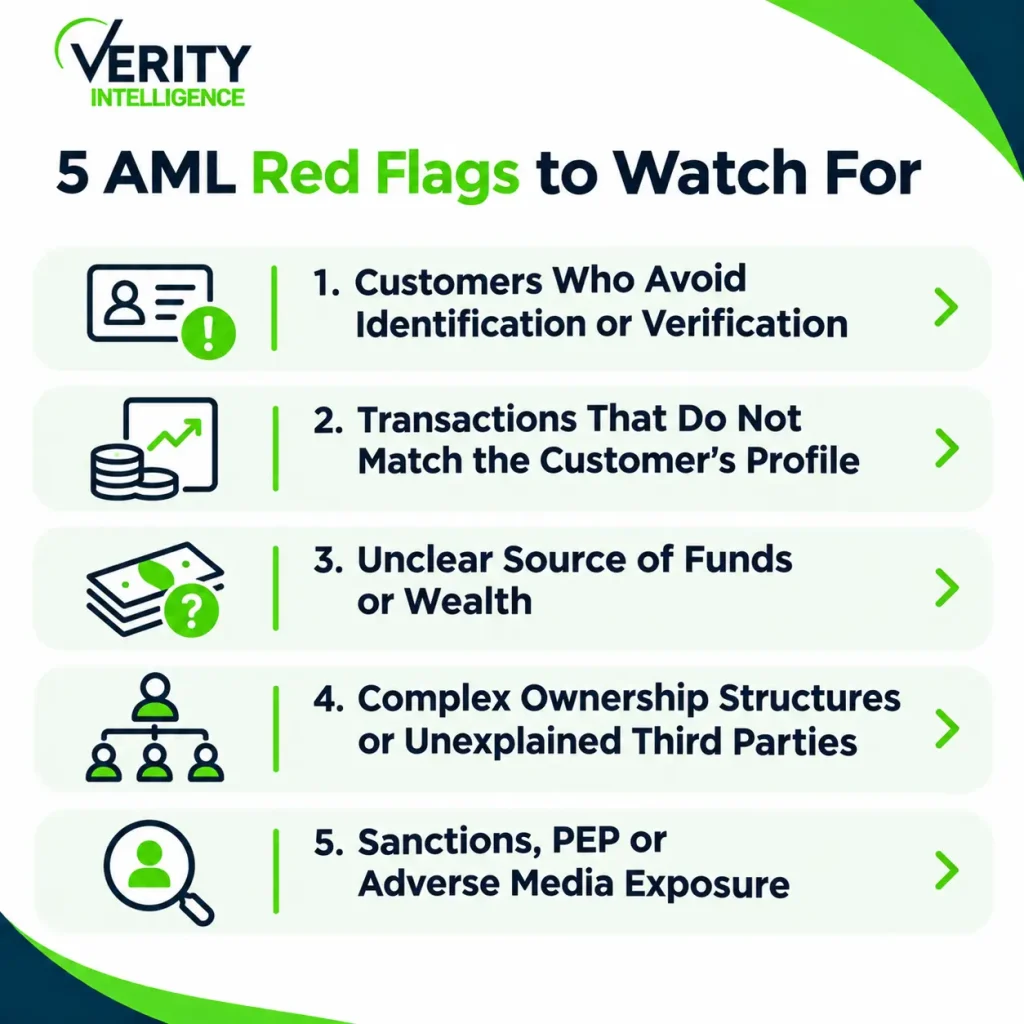
1. Customers Who Avoid Identification or Verification
The first warning sign can appear before a business relationship begins.
A customer may refuse to provide identification, repeatedly submit inconsistent documents or avoid explaining who ultimately controls a company. Others may insist that an unrelated person handle communications without a clear reason.
Example: A company secretarial firm receives instructions to incorporate a company, but the applicant repeatedly avoids questions about its beneficial owners.
This matters because institutions need sufficient information to identify customers and understand relevant ownership or control arrangements. Incomplete information can make an appropriate risk assessment difficult.
What to do: Request clarification, verify relevant details through reliable sources and document unresolved discrepancies. If required CDD cannot be completed, follow the applicable procedures before proceeding.
2. Transactions That Do Not Match the Customer’s Profile
An unusual transaction is not necessarily illegal. However, activity that differs significantly from a customer’s known business or financial circumstances may deserve closer attention.
Watch for unexplained increases in transaction value, frequent transfers without a clear purpose or arrangements that appear unnecessarily complicated.
Example: An accounting firm notices that a small trading business suddenly records substantial transactions unrelated to its usual operations, with no convincing commercial explanation.
The concern is not simply the amount involved. It is the inconsistency between the transaction and what the institution knows about the customer.
What to do: Compare the activity with the customer’s profile, seek appropriate explanations and consider whether the overall pattern warrants escalation. Ongoing monitoring helps identify changes that a one-time onboarding review might miss.
3. Unclear Source of Funds or Wealth
A customer may provide valid identification yet be unable to explain where money used in a transaction originated.
This can arise when payments are made by unrelated third parties, funds move through unexpected accounts or the customer’s declared financial position does not reasonably support the transaction.
Example: A moneylender receives an unexpectedly large early repayment from a borrower whose stated income does not explain the payment. The borrower cannot clarify the source of the funds.
Similarly, a property professional may encounter a purchaser whose financing comes from several unidentified parties.
What to do: Assess whether additional information about the source of funds or wealth is necessary under the applicable risk-based requirements. Record the explanation and supporting evidence, and escalate concerns that remain unresolved.
An unexplained payment is a warning sign, not a conclusion about the customer’s conduct.
4. Complex Ownership Structures or Unexplained Third Parties
Companies, trusts and cross-border ownership structures often have legitimate purposes. Complexity becomes a concern when it prevents a reporting institution from understanding who ultimately owns or controls a customer.
Warning signs include unexplained nominee arrangements, frequent ownership changes or individuals directing transactions without an apparent connection to the customer.
Example: A trust company is asked to establish an arrangement involving several corporate layers, but the parties cannot provide a clear explanation of who exercises ultimate control.
What to do: Identify and verify relevant beneficial owners, understand the ownership structure and assess whether enhanced due diligence is appropriate. Where separate verification needs arise, Verity Intelligence’s comprehensive background check services can support suitable background verification, subject to applicable requirements.
The objective is to understand who controls the transaction.
5. Sanctions, PEP or Adverse Media Exposure
Some risks cannot be identified from customer-provided documents alone. Screening may reveal a potential sanctions match, a politically exposed person (PEP) connection or relevant adverse media concerning a customer or beneficial owner.
Example: During onboarding, a jeweller identifies a potential sanctions-list match involving a customer. Further checks are needed to determine whether the result relates to the same person.
A PEP connection does not establish wrongdoing. Likewise, an adverse media report or possible name match must be assessed for accuracy and relevance. Confirmed sanctions matches may trigger specific legal obligations requiring prompt action.
What to do: Review identifiers, investigate potential matches and follow the institution’s escalation and sanctions procedures. VERISafe instant risk screening can help identify relevant sanctions, watchlist, PEP and adverse media indicators for review.
How AML Red Flags Differ Across Industries
The same underlying risk may appear differently depending on the business. Reporting institutions should therefore develop internal warning signs suited to their activities.
| Industry | Example of a Potential Warning Sign |
|---|---|
| Company Secretaries | Difficulty identifying beneficial owners |
| Lawyers | Unexplained third-party involvement in a client transaction |
| Accountants | Transactions inconsistent with normal business activity |
| Real Estate Agents | Property purchases with unclear funding sources |
| Jewellers | High-value purchases using unusual payment arrangements |
| Moneylenders | Unexpected repayments from unexplained sources |
| Trust Companies | Ownership structures with unclear ultimate control |
Assess each indicator in context.
What Should a Reporting Institution Do After Spotting a Red Flag?
Recognising a warning sign is only the first step. Institutions need a consistent response that reflects their policies and legal obligations.
- Review the facts. Check whether the information is accurate, relevant and supported by available evidence.
- Seek appropriate clarification. Obtain explanations or documents when doing so is suitable and does not compromise applicable confidentiality requirements.
- Assess and document the risk. Consider the customer’s profile, the transaction’s purpose and any additional indicators. Record the rationale for the assessment.
- Escalate unresolved concerns. Refer potential suspicious activity to the designated compliance officer through established internal procedures.
- Consider suspicious transaction reporting. Under the applicable framework, suspicion or reasonable grounds for suspicion may require a Suspicious Transaction Report (STR), including for attempted transactions and regardless of amount. Avoid tipping off customers or unauthorised parties.
Not every red flag results in an STR. The decision depends on the circumstances and applicable reporting requirements.
How Risk Screening Supports Customer Due Diligence
Customer risk can change after onboarding. New sanctions designations, relevant news or other developments may require a reporting institution to reassess an existing relationship.
Structured screening helps teams identify potential concerns more consistently. VERISafe by Verity Intelligence provides instant screening against available global and local sanctions, watchlists, PEP information, adverse media, and selected Malaysian police postings and court records.
This can support initial onboarding, event-driven reviews and periodic screening where appropriate. Potential matches still require human assessment; screening results are not findings of guilt.
Importantly, VERISafe supports only the risk-screening component of a wider AML programme. It does not replace identity verification, beneficial ownership checks, transaction monitoring, internal investigations or STR decisions.
For organisations considering different levels of verification, explore Verity Intelligence’s background screening solutions to understand the available options.
Conclusion: Recognise Risks Before They Escalate
The five AML red flags – incomplete customer information, unusual transactions, unexplained funds, unclear ownership and relevant screening exposure – can appear in many different industries.
For Malaysian reporting institutions, recognising these indicators helps strengthen CDD, support informed decisions and ensure concerns reach the right people for assessment.
A red flag is a reason to investigate, not a reason to assume wrongdoing. Clear procedures, reliable information and appropriate escalation are essential.
To strengthen the screening component of your customer due diligence process, contact Verity Intelligence to learn how VERISafe may support your organisation.