
A new client approaches your corporate secretarial firm to incorporate a company.
The documents are complete. The proposed directors are identified. The shareholders are listed, and everything appears straightforward.
But there is one important question:
Do you know who actually owns or controls the company?
The person whose name appears on the company registration documents may not always be the individual exercising ultimate control.
Sometimes, ownership extends through several companies. In other situations, someone may exercise control through agreements, arrangements, or nominee structures.
For Malaysian company secretaries, understanding who ultimately owns or controls a client company is more than an administrative concern.
It is an important part of corporate transparency, beneficial ownership verification, and applicable anti-money laundering and counter-terrorism financing (AML/CFT) obligations.
This is where proper customer due diligence and background screening become essential.
What Is Beneficial Ownership?
A beneficial owner is the individual who ultimately owns or controls a company, whether directly or indirectly.
This is different from simply identifying the person whose name appears on the company’s registration documents.
For example, consider a hypothetical Malaysian company with the following ownership structure:
- Company A is owned by Company B.
- Company B is owned by Company C.
- Company C is ultimately controlled by an individual.
Although Company B appears as a shareholder of Company A, the beneficial ownership assessment may need to examine the ownership chain to identify the individual exercising ultimate ownership or control.
A beneficial owner must be a natural person, not another company.
Under Malaysia’s Companies Act 2016, as amended by the Companies (Amendment) Act 2024, beneficial ownership includes individuals who ultimately own or control a company through shares or exercise ultimate effective control.
This means knowing the registered shareholders is not always the same as identifying the beneficial owners.
Why Beneficial Ownership Matters to Company Secretaries in Malaysia
Company secretaries play an important role in corporate governance, statutory compliance, and maintaining company records.
Malaysia strengthened its beneficial ownership reporting framework through the Companies (Amendment) Act 2024, with the relevant provisions coming into effect on 1 April 2024.
The framework introduced provisions addressing the identification, recording, updating, and reporting of beneficial ownership information.
The Companies Commission of Malaysia (SSM) subsequently revised its beneficial ownership reporting guidelines in January 2025.
For corporate secretarial practitioners, this makes it important to understand the distinction between documenting ownership information and conducting additional risk-based checks.
Companies have statutory obligations to maintain and report beneficial ownership information, while company secretaries may also have separate AML/CFT responsibilities when acting as reporting institutions for relevant activities.
These obligations should be assessed according to the applicable law, guidance, and services being provided.
For detailed requirements, refer to the Companies Commission of Malaysia’s beneficial ownership reporting framework.
5 Risks of Not Knowing Who Really Owns Your Client’s Company
Failing to identify or appropriately verify beneficial ownership can expose a corporate secretarial firm to compliance and reputational concerns.
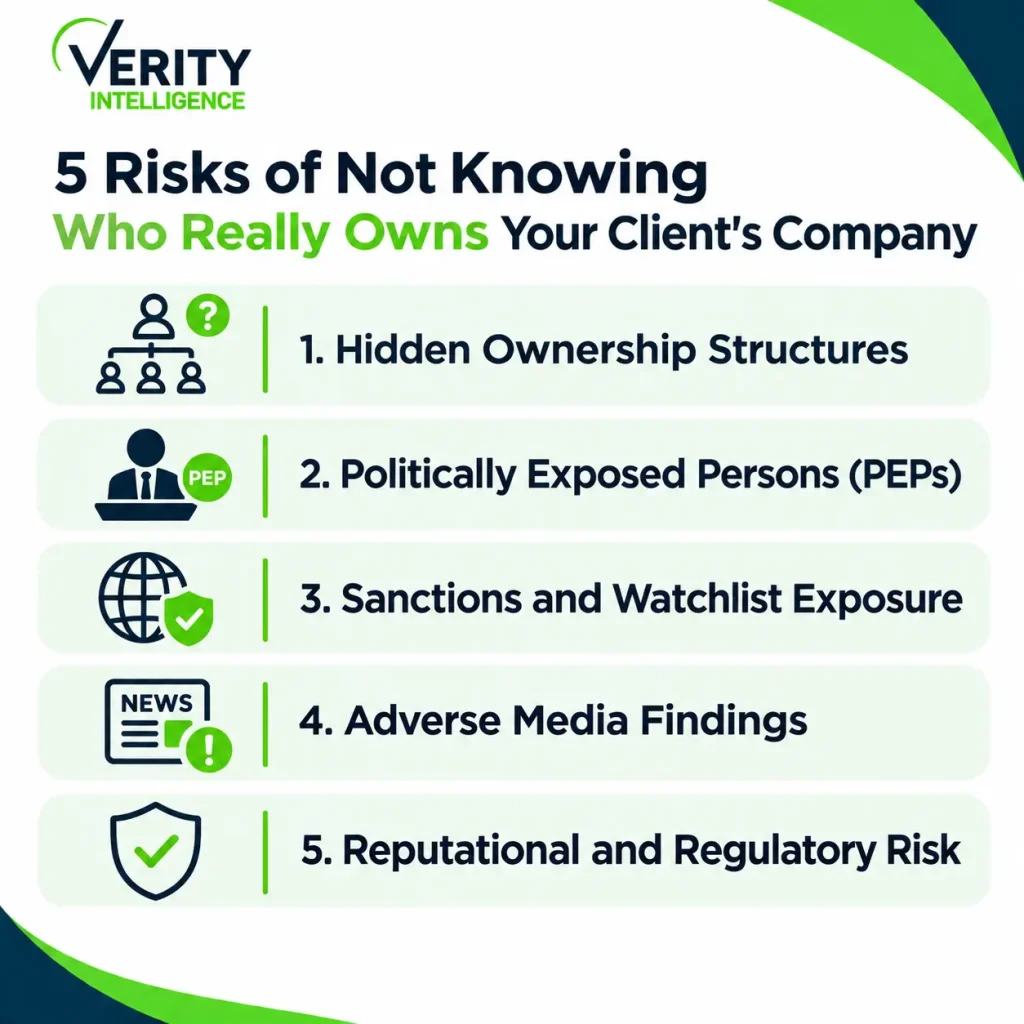
Here are five risks worth understanding.
1. Hidden Ownership Structures
A company may have multiple layers of corporate ownership.
While complex structures are not necessarily suspicious, they can make it harder to identify the individuals exercising ultimate control.
Without appropriate verification, important information about the ownership structure may remain unclear.
2. Politically Exposed Persons (PEPs)
A beneficial owner may be a politically exposed person.
Being a PEP does not automatically indicate wrongdoing. However, PEP relationships can require additional scrutiny under applicable AML/CFT requirements.
Identifying relevant PEP connections helps company secretaries assess whether enhanced due diligence may be necessary.
3. Sanctions and Watchlist Exposure
A company’s beneficial owner may have a potential match against a relevant sanctions list or watchlist.
Failure to identify applicable sanctions exposure can create serious compliance concerns.
Sanctions screening helps identify potential matches that should be reviewed before a business relationship proceeds.
4. Adverse Media Findings
A beneficial owner may be linked to credible reports involving alleged fraud, corruption, financial misconduct, or other relevant concerns.
An adverse media finding does not establish guilt.
However, it can provide information that supports a more informed assessment of a client’s risk profile.
5. Reputational and Regulatory Risk
Corporate secretarial firms build their reputation on professionalism, reliability, and compliance.
If a client is later linked to serious financial crime or regulatory concerns, questions may arise about the firm’s onboarding procedures and customer due diligence.
Appropriate beneficial ownership checks and documented risk assessments can help firms demonstrate a more responsible approach to onboarding.
Is Checking SSM Records Enough?
SSM records are an essential starting point for identifying and documenting corporate ownership.
However, corporate records and risk screening serve different purposes.
A company may have properly maintained beneficial ownership information while an identified beneficial owner has relevant sanctions exposure, PEP connections, or adverse media findings.
These risk indicators may require additional due diligence.
For company secretaries subject to applicable AML/CFT obligations, customer due diligence involves more than collecting identification documents.
It includes understanding the customer, identifying relevant beneficial owners, assessing risk, and applying appropriate verification procedures.
Corporate records help establish who owns or controls a company. Background screening helps assess relevant risk indicators associated with the identified individuals or entities.
Both can support a stronger due diligence process.
How Background Screening Supports Beneficial Ownership Due Diligence
Once the relevant beneficial owners have been identified, appropriate background screening can support further risk assessment.
Depending on the purpose and screening scope, this may include:
- Sanctions and watchlist screening
- Politically exposed persons screening
- Adverse media screening
- Relevant regulatory information
- Available integrity-related records
- Additional background checks where appropriate
For example, a company secretary may identify an individual as the beneficial owner of a new client company.
A screening exercise may then identify a possible sanctions or adverse media match involving someone with a similar name.
That finding should not automatically lead to rejection.
Instead, the firm should verify the match, review relevant identifiers, assess the information, and determine whether further due diligence is needed.
This distinction is important because a screening alert is not proof of wrongdoing.
Responsible screening supports decision-making rather than replacing professional judgment.
When Should Company Secretaries Conduct Screening?
For corporate secretarial firms subject to applicable AML/CFT requirements, customer due diligence and screening should be integrated into relevant onboarding and ongoing review procedures.
Situations that may require attention include:
Before Establishing a Business Relationship
Identify the customer and relevant beneficial owners, assess the relationship, and complete applicable due diligence before proceeding.
When Ownership or Control Changes
Changes in shareholders, beneficial owners, or control arrangements may require updated information and a reassessment of risk.
When Potential Risk Indicators Emerge
Relevant adverse media, sanctions exposure, unusual activity, or inconsistencies in client information may justify additional review.
During Periodic Customer Reviews
Existing client relationships should be reviewed according to the firm’s applicable obligations, internal controls, and risk-based procedures.
Higher-risk relationships may require enhanced due diligence.
For example, company secretaries providing nominee services should pay particular attention to the enhanced customer due diligence requirements applicable to those services.
Why Beneficial Ownership Screening Is Relevant to Small Secretarial Firms
Some smaller company secretarial practices may assume that advanced screening procedures are mainly relevant to large financial institutions.
However, AML/CFT risks are not determined by the size of a professional firm.
A small corporate secretarial practice may serve clients with complex ownership structures, foreign shareholders, or business activities requiring closer assessment.
For smaller practices, developing a consistent screening process can help improve efficiency and reduce dependence on informal manual searches.
The objective is not to conduct every possible background check on every client.
Instead, firms should adopt screening and verification procedures that reflect the nature of the engagement, applicable regulatory requirements, and assessed risk.
For corporate secretarial firms looking to strengthen their client due diligence process, VERISafe provides instant risk screening to help identify potential sanctions, PEP, adverse media, and other relevant risk indicators.
How VERISafe Supports Company Secretaries with Risk Screening
Identifying beneficial owners is an important starting point. Understanding relevant risk indicators associated with those individuals is another part of effective due diligence.
At Verity Intelligence, we help organizations strengthen their risk screening processes through solutions such as VERISafe and Verity BGC.
VERISafe – Instant Risk Screening
VERISafe provides instant screening against available risk databases, including:
- Sanctions and watchlists
- Politically exposed persons (PEPs)
- Adverse media
- Relevant police postings and court records
- Other available integrity-related risk information
For company secretaries, VERISafe can support screening of identified clients, beneficial owners, directors, and relevant individuals or entities as part of customer due diligence.
Its instant screening capabilities can also support periodic re-screening of existing client relationships.
However, VERISafe does not independently establish a company’s complete beneficial ownership structure or replace statutory beneficial ownership reporting to SSM.
The beneficial owners must first be identified through appropriate corporate records and verification procedures.
Verity BGC – Comprehensive Background Checks
For situations requiring more detailed verification, Verity BGC provides comprehensive screening options, including relevant litigation checks, business interests, directorship information, and other verification services depending on the scope selected.
Together, these solutions can support a broader risk-based approach to customer due diligence.
They complement, rather than replace, the firm’s responsibilities for beneficial ownership identification, AML/CFT compliance, recordkeeping, and professional judgment.
Conclusion: Knowing the Company Is Not Enough. Know Who Controls It.
For company secretaries, corporate due diligence should not stop at collecting company registration documents.
Understanding who ultimately owns or controls a client company is an important foundation for corporate transparency and applicable AML/CFT compliance.
A company may appear straightforward on paper, but its ownership arrangements and relevant risk indicators may require closer examination.
Beneficial ownership verification establishes who ultimately owns or controls the company. Background screening helps identify relevant risks associated with those individuals.
By combining appropriate ownership verification with risk-based screening, company secretaries can strengthen their onboarding processes and make more informed decisions.
Verity Intelligence’s VERISafe can support this process through instant screening against relevant risk databases.
Before accepting your next client, make sure you understand who is behind the company and what relevant risks may need further review.
Know who you are dealing with. Screen before you commit.
To learn how VERISafe can support your firm’s screening process, contact Verity Intelligence.