
You have found a supplier offering competitive prices, fast delivery and attractive payment terms.
Their quotation looks professional. Their representative seems reliable. Everything appears ready for you to sign the agreement.
But have you checked who you are actually doing business with?
A good quotation tells you what a supplier promises. It does not necessarily tell you whether the supplier can be trusted to deliver.
Behind an attractive proposal, there may be unresolved legal disputes, financial concerns, regulatory issues or adverse information that your business has not considered.
This is where supplier background screening becomes important.
Whether you operate an SME, manufacturing company, retail business or large corporation in Malaysia, conducting an appropriate background check can help you identify relevant risks before committing your money, operations or reputation.
Why Supplier Background Screening Matters
Most businesses evaluate suppliers based on price, product quality, delivery timelines and service capabilities.
While these factors are important, they do not provide a complete picture of the risks involved.
A supplier may be responsible for providing essential materials, accessing your company premises, handling confidential information or supporting critical operations.
Once the agreement is signed, your business may become dependent on that supplier.
Imagine a Malaysian manufacturing company that relies on a new supplier for essential production components.
The supplier offers competitive pricing and promises consistent delivery. However, several months into the relationship, the supplier encounters serious financial difficulties and cannot fulfill its orders.
Production slows down, customer deliveries are delayed and the manufacturer must urgently find an alternative supplier.
Although this is a hypothetical example, it illustrates how supplier-related problems can affect the entire business.
Supplier background screening helps organizations identify relevant warning signs before committing to a business relationship.
5 Hidden Risks of Working with an Unverified Supplier
Supplier risks are not always visible during negotiations. Some concerns only become apparent after the contract is signed.
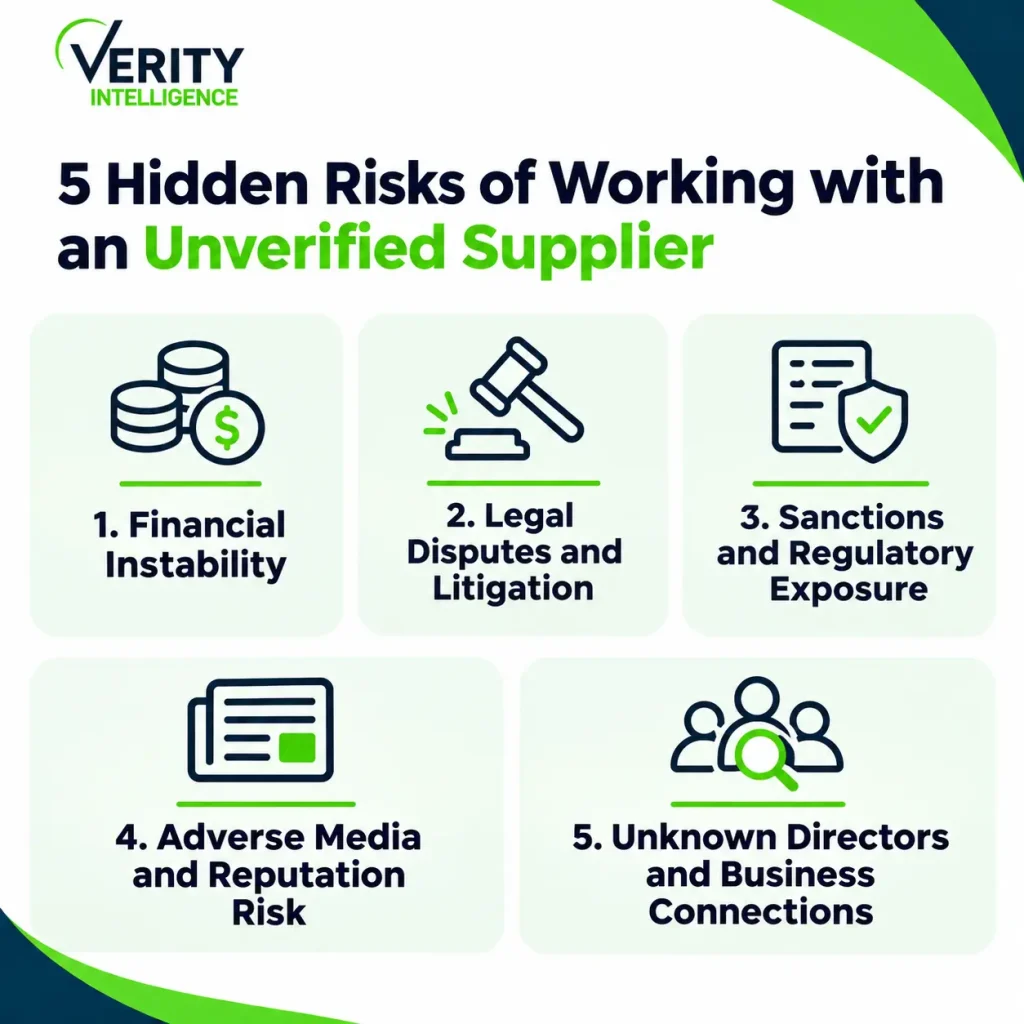
Here are five areas businesses should pay attention to.
1. Financial Instability
A supplier may appear financially stable while facing significant financial difficulties.
These problems can affect its ability to deliver products, pay employees or maintain operations.
For example, a supplier experiencing cash flow difficulties may request substantial advance payments but later struggle to fulfill an order.
Financial assessments, where appropriate, can help businesses evaluate potential concerns before committing to a long-term relationship.
2. Legal Disputes and Litigation
A supplier may have ongoing or historical legal disputes involving customers, employees, creditors or business partners.
Not every legal dispute indicates wrongdoing. However, repeated or significant litigation may require further review.
A comprehensive supplier background check may include relevant litigation searches to help businesses understand potential legal exposure.
The key is to assess the nature and relevance of any findings rather than automatically rejecting a supplier because a record exists.
3. Sanctions and Regulatory Exposure
Some suppliers may be linked to individuals, companies or activities appearing on sanctions lists or relevant regulatory databases.
Depending on the business and applicable requirements, these relationships may create legal, financial or reputational concerns.
Sanctions and watchlist screening can help identify potential matches that require verification and further investigation.
4. Adverse Media and Reputation Risk
A supplier’s reputation can affect your company’s reputation.
Imagine discovering that one of your business partners has been repeatedly mentioned in credible news reporting concerning alleged fraud or serious business misconduct.
Even when your organization was not involved, customers may question why that supplier was selected.
Adverse media screening helps businesses identify relevant negative coverage and assess potential reputational risks before forming a relationship.
5. Unknown Directors and Business Connections
Do you know who owns or manages the company supplying your business?
Understanding a supplier’s directors, shareholders and relevant business interests can help identify potential conflicts of interest or concerning business connections.
For Malaysian companies, official corporate information can be obtained through the Companies Commission of Malaysia (SSM).
SSM company profiles can include registration information, company status, directors, shareholders and other corporate details.
These records provide a useful foundation for supplier verification, although they do not replace broader due diligence.
Is SSM Registration Enough to Verify a Supplier?
Many Malaysian business owners assume that checking a supplier’s SSM registration is enough.
It is a good starting point, but company registration does not automatically mean the supplier is reliable or free from risk.
A registered business may still experience financial difficulties, operational problems, regulatory concerns or unresolved legal disputes.
For example, a supplier may have valid registration documents but lack the financial or operational capability to fulfill a large contract.
This is why organizations should consider combining corporate verification with relevant background screening.
The objective is not simply to confirm that a company exists.
It is to better understand the risks involved in doing business with that company.
Which Suppliers Should Your Business Screen?
Not every supplier carries the same level of risk.
A stationery supplier delivering ordinary office supplies may require a different screening approach from an IT contractor with access to confidential customer information.
For Malaysian businesses, supplier screening may be particularly relevant in the following situations.
Manufacturing and Industrial Suppliers
- Manufacturers depend on reliable suppliers to maintain production.
- Relevant background checks can help identify legal, financial or reputational concerns that may affect business continuity.
IT and Technology Service Providers
- Technology vendors may access company networks, systems and confidential information.
- Background screening can support supplier selection alongside cybersecurity assessments, contractual safeguards and access controls.
Logistics and Transportation Providers
- Logistics suppliers may handle valuable goods, delivery schedules and customer information.
- Screening can help identify relevant integrity or business risks before engaging a transportation partner.
Security, Cleaning and Maintenance Contractors
- These suppliers may access offices, warehouses, schools, residential properties and other sensitive environments.
- Screening the supplier and relevant personnel can support safer site access and contractor onboarding.
Finance and Payroll Service Providers
- Outsourced finance providers may handle confidential financial records, employee information and payment processes.
- Appropriate due diligence can help businesses assess relevant risks before granting access to sensitive information.
Why SMEs Should Not Ignore Supplier Background Checks
Some small business owners believe supplier background screening is only necessary for banks, multinational corporations or heavily regulated industries.
However, smaller businesses also depend on suppliers.
For an SME, a single unreliable supplier can affect cash flow, stock availability, customer satisfaction and daily operations.
Consider a small retailer that pays a substantial deposit to a new supplier without conducting basic verification.
If the supplier fails to deliver, the retailer may experience financial pressure and lose valuable sales opportunities.
This does not mean background checks can guarantee that every supplier will perform successfully.
However, they can help reduce uncertainty and identify relevant risk indicators before a commitment is made.
For SMEs that require occasional comprehensive verification, Verity’s prepaid background check packages provide an option for accessing screening services through prepaid credits.
How to Conduct Supplier Background Screening in Malaysia
Supplier screening should follow a structured, risk-based approach.
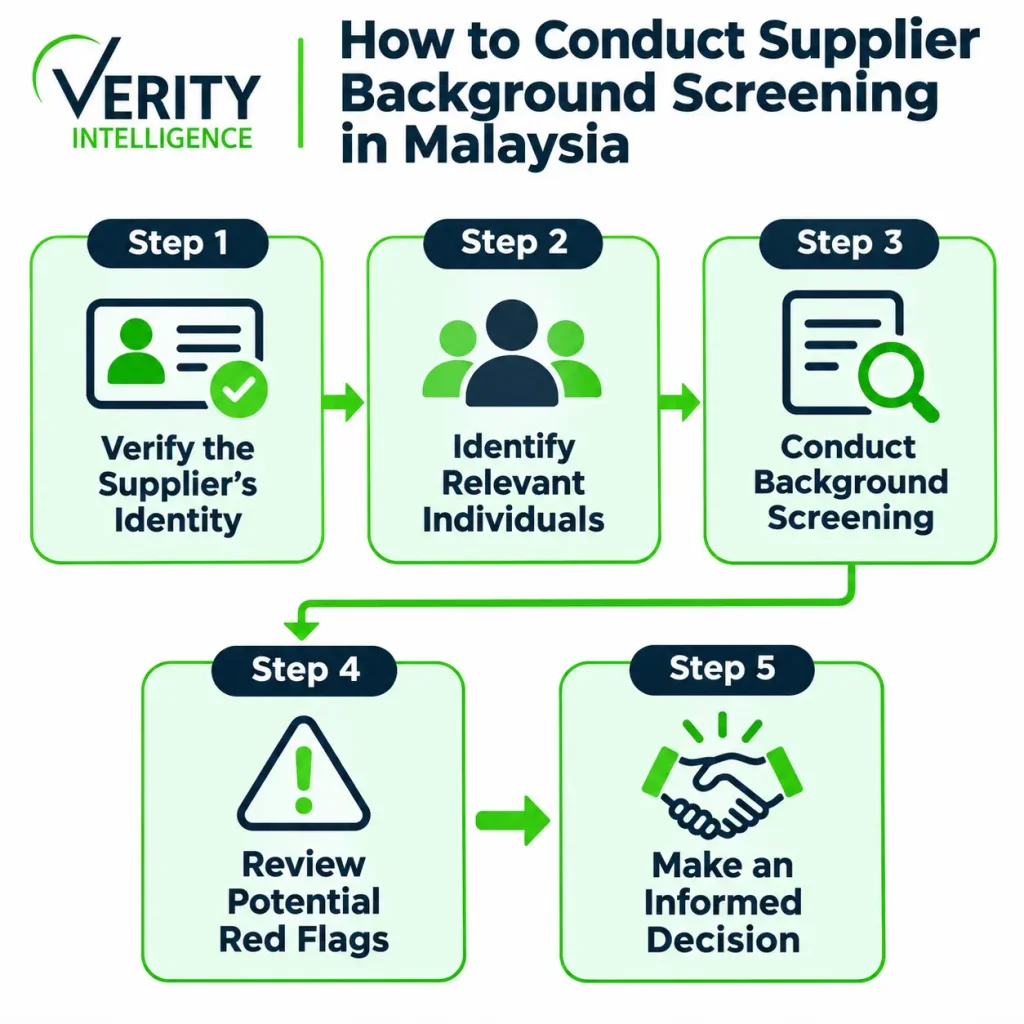
Step 1: Verify the Supplier’s Identity
Confirm the registered business name, registration number, company status and relevant business details.
Step 2: Identify Relevant Individuals
Review directors, shareholders and key individuals where appropriate.
Step 3: Conduct Background Screening
Screen relevant entities and individuals against appropriate sanctions lists, watchlists, adverse media sources and other risk databases.
Step 4: Review Potential Red Flags
A screening match does not automatically mean wrongdoing.
Verify the identity, accuracy and relevance of the information before reaching a conclusion.
Step 5: Make an Informed Decision
Consider the screening findings alongside financial assessments, operational capability, commercial requirements and contractual protections.
Where personal information is involved, organizations should also observe applicable privacy and data protection requirements.
How VERISafe Helps Businesses Screen Suppliers Earlier
Supplier background screening should not necessarily be a complicated or time-consuming process.
At Verity Intelligence, we help organizations strengthen their screening processes through solutions designed for different verification needs.
VERISafe provides instant risk screening against relevant databases, including sanctions, watchlists, politically exposed persons, adverse media and available integrity-related records.
For procurement and compliance teams, VERISafe can help identify potential risk indicators before onboarding a supplier.
It can also support periodic re-screening of existing suppliers, helping businesses maintain risk visibility as relationships continue.
Where deeper verification is required, Verity BGC offers comprehensive background checks, including relevant litigation, financial probity and business interest searches, depending on the selected scope.
These solutions can complement broader supplier due diligence, but they do not replace financial audits, technical assessments or supplier performance evaluations.
Conclusion: A Good Price Does Not Always Mean a Good Supplier
Choosing the right supplier involves more than comparing quotations.
The lowest price may not be the best decision if the relationship exposes your business to unnecessary financial, operational, compliance or reputational risks.
Before signing an agreement, ask yourself:
Do I know enough about the company I am about to trust?
Supplier background screening helps organizations identify relevant warning signs, review potential concerns and make more informed decisions before committing to a business relationship.
A good supplier offers value. A properly screened supplier gives you greater confidence.
Before you sign your next supplier agreement, consider how VERISafe can support faster, more informed risk screening.
Contact Verity Intelligence to explore the appropriate screening solution for your business.