
A customer walks into a jewellery store, selects an expensive gold necklace and is ready to pay without asking many questions. For a sales team, this may look like a successful transaction. For a compliance team, the surrounding circumstances may deserve a closer look.
Jewellery dealers in Malaysia handle valuable products and transactions involving different customers, payment methods and purchasing arrangements. These characteristics can expose businesses to financial crime risks.
Recognising money laundering red flags helps jewellers identify unusual activities, strengthen customer due diligence and protect their business reputation without treating every customer as suspicious.
Here are ten warning signs that goldsmiths, jewellers and dealers in precious stones should understand.
Why Jewellery Dealers Need to Be Aware of Money Laundering Risks
Gold, diamonds and other precious materials can retain significant value in relatively small physical items. They can also be traded through legitimate retail and wholesale markets. These characteristics make the sector attractive to genuine customers but potentially vulnerable to financial crime.
In Malaysia, dealers in precious metals or precious stones (DPMS) are among the designated non-financial businesses and professions (DNFBPs) covered by the applicable anti-money laundering framework.
Bank Negara Malaysia’s AML/CFT policy documents set out requirements for relevant reporting institutions, including customer due diligence (CDD), risk assessment, record keeping and suspicious transaction reporting.
10 Money Laundering Red Flags Jewellery Dealers Should Recognise
The following examples are practical illustrations of potential concerns. No single indicator automatically establishes money laundering. Staff should consider the circumstances and refer concerns through their internal procedures.
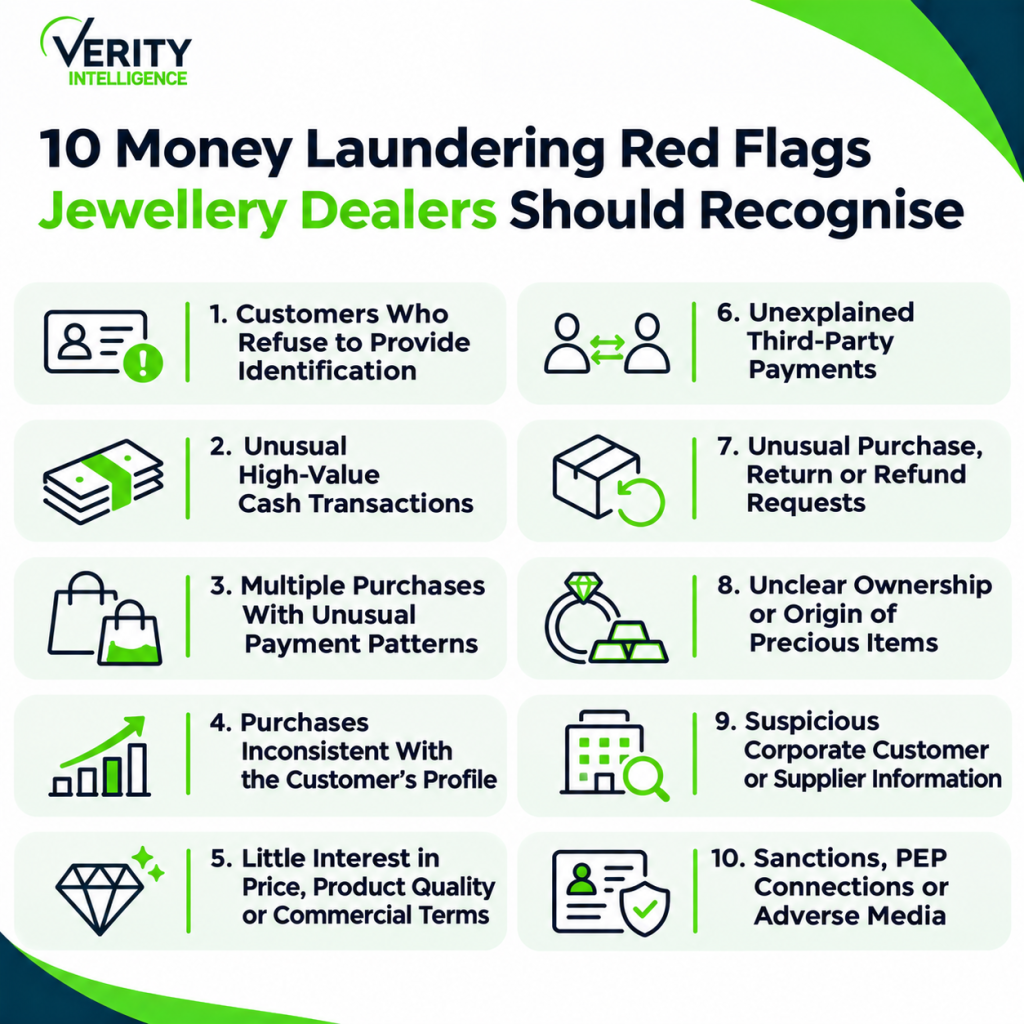
1. Customers Who Refuse to Provide Identification
A customer may become defensive when asked for identification or provide documents containing inconsistent personal details.
Example: A buyer agrees to a substantial jewellery purchase but refuses to provide information required under the dealer’s CDD procedures.
What to do: Explain why the information is required, verify relevant documents and escalate unresolved concerns. Follow applicable restrictions on proceeding if mandatory due diligence cannot be completed.
2. Unusual High-Value Cash Transactions
Cash remains a legitimate payment method in Malaysia. However, a substantial cash payment that appears inconsistent with the customer’s known circumstances may deserve further attention.
Example: A customer arrives with a significant amount of cash and gives conflicting explanations about the purpose of the purchase.
What to do: Apply the relevant CDD requirements, record transaction details and refer unexplained inconsistencies for review. The payment method alone should not determine suspicion.
3. Multiple Purchases With Unusual Payment Patterns
Purchases should be assessed in context, particularly when separate payments or orders appear connected in a way that lacks a reasonable commercial explanation.
Example: Staff identify inconsistencies across several related invoices involving the same customer.
What to do: Review available transaction records together, clarify the circumstances where appropriate and assess the activity under the dealer’s compliance procedures. Branches should communicate relevant concerns through authorised channels.
4. Purchases Inconsistent With the Customer’s Profile
A customer’s spending may differ significantly from the information already known about their financial or business activities. This does not mean that people should be judged by their appearance or occupation.
Example: An established wholesale customer suddenly places orders far outside its normal purchasing activity without explaining the change.
What to do: Consider objective information, such as previous orders and the customer’s stated business purpose. Seek clarification where appropriate rather than relying on personal assumptions.
5. Little Interest in Price, Product Quality or Commercial Terms
Customers buying valuable jewellery often consider design, purity, certification or price. An unusual lack of interest in commercial terms may warrant attention when accompanied by other concerns.
Example: A buyer accepts conflicting quotations and provides inconsistent instructions regarding a valuable order.
What to do: Document the unusual circumstances and consider whether other indicators are present. Some legitimate customers value convenience more than price, so this behaviour alone is insufficient to establish suspicion.
6. Unexplained Third-Party Payments
A customer may legitimately receive financial support from a family member or business associate. Concerns arise when the relationship between a purchaser and payer cannot be reasonably explained.
Example: A buyer provides conflicting information about the unrelated company paying for an order.
What to do: Establish the relevant parties and their roles, obtain information required by applicable procedures and escalate unresolved discrepancies.
7. Unusual Purchase, Return or Refund Requests
Returns and refunds are normal retail activities. However, requests that are inconsistent with the original purchase or lack a credible explanation may require closer examination.
Example: A customer disputes the recorded payment details and requests a refund inconsistent with the original transaction.
What to do: Follow approved refund procedures, reconcile payment records and obtain internal approval for exceptions. Document concerns instead of allowing commercial pressure to override established controls.
8. Unclear Ownership or Origin of Precious Items
Dealers that purchase second-hand jewellery or precious metals from customers should pay attention to inconsistencies surrounding ownership and provenance.
Example: A seller provides conflicting accounts of how several valuable items were acquired and cannot substantiate the information when asked.
What to do: Check relevant ownership information and available documentation in accordance with the business’s procedures. Escalate concerns about potentially unlawful origins before deciding how to proceed.
9. Suspicious Corporate Customer or Supplier Information
Jewellery businesses also deal with wholesalers, corporate buyers and suppliers. Inconsistent business records or unclear ownership can complicate risk assessment.
Example: A new corporate buyer submits invoices and registration information that contain unexplained differences.
What to do: Verify relevant business details and identify beneficial owners where required. For separate, more detailed verification needs, Verity Intelligence’s comprehensive background check services offer additional options, subject to applicable permissions.
10. Sanctions, PEP Connections or Adverse Media
Some risks may not be visible during a transaction. Screening can identify potential sanctions matches, politically exposed person (PEP) connections or relevant reports of alleged misconduct.
Example: A screening check returns a possible sanctions match involving a corporate customer’s beneficial owner.
What to do: Compare identifying information, review the relevance of findings and follow applicable sanctions and escalation procedures. PEP status or adverse media alone does not establish wrongdoing. VERISafe instant risk screening can help identify potential matches for further assessment.
When Should Jewellery Dealers Conduct Customer Due Diligence?

CDD helps dealers understand who they are transacting with and assess relevant risks. It includes identifying customers, verifying information and undertaking additional checks when required by the circumstances.
For precious metals and stones dealers, BNM sets sector-specific conditions for when CDD is mandatory. Dealers should consult the applicable policy for transaction thresholds, connected payments and requirements for both purchases and sales.
Suspicious activity must be assessed regardless of transaction value. A transaction below a prescribed threshold is not automatically low risk.
What Should Jewellery Dealers Do When a Red Flag Appears?
A consistent response helps frontline staff handle concerns professionally without making unsupported accusations against customers.
- Review the facts: Check the available records and identify what is inconsistent or unusual.
- Clarify information: Obtain relevant explanations or documents where appropriate and legally permissible.
- Document concerns: Maintain records of findings, decisions and any subsequent action.
- Escalate internally: Refer unresolved concerns to the designated compliance officer.
- Fulfil reporting obligations: Follow applicable suspicious transaction reporting and confidentiality requirements, including avoiding tipping off.
Staff training is equally important. Employees working at sales counters, purchasing desks and payment processing functions should know who to contact when a concern arises.
How VERISafe Supports AML Compliance for Jewellery Dealers
Manually checking multiple information sources can be challenging for jewellery businesses handling customers across several branches.
VERISafe by Verity Intelligence provides instant risk screening against available global and local sanctions, watchlists, PEP information, adverse media and selected Malaysian police postings and court records.
It can help dealers identify potential risk indicators during customer onboarding and conduct repeat screening when appropriate. A structured screening process also helps staff apply consistent checks across business locations.
However, VERISafe does not independently verify identity documents, establish beneficial ownership, monitor payment transactions or determine whether an STR is required. Screening findings require review and should form part of a wider compliance process.
Explore Verity Intelligence’s screening solutions to understand the options available for different business needs.
Conclusion: Protect Your Jewellery Business With Better Risk Awareness
Recognising money laundering red flags is an important step towards responsible business practices. By understanding unusual customer behaviour, reviewing transaction inconsistencies and conducting appropriate due diligence, jewellery dealers can make better-informed decisions.
The goal is not to question every customer. It is to ensure that genuine concerns are recognised, assessed and escalated consistently.
Contact Verity Intelligence to learn how VERISafe can support the risk-screening component of your jewellery business’s AML compliance programme.