

Every loan begins with a level of trust. A borrower submits an application, provides supporting documents and agrees to repay the borrowed amount.
But how much do you really know about the person behind that application?
A borrower may have a stable income, valid identification documents and an acceptable credit profile. Yet these details may not reveal potential connections to financial crime, sanctions, suspicious activities or undisclosed third parties.
For moneylenders in Malaysia, evaluating a borrower’s financial capacity is important. However, knowing who you are lending to goes beyond assessing whether someone can repay a loan.
This is where moneylender background checks and Customer Due Diligence (CDD) become valuable.
By understanding borrowers and identifying potential warning signs early, moneylenders can strengthen their risk management practices and reduce exposure to financial crime.
Why Moneylenders Need to Know Their Borrowers
Moneylenders provide an important financing option for individuals and businesses. However, lending activities can also be vulnerable to misuse.
For example, a borrower may obtain financing using misleading information, repay a loan with funds from unexplained sources or involve third parties whose relationship to the transaction is unclear.
Some activities may appear commercially reasonable at first but become suspicious when examined alongside the customer’s profile and transaction history.
A moneylender background check can help identify relevant risk indicators that might otherwise go unnoticed.
These checks complement financial assessments by helping lenders understand potential integrity and financial crime risks associated with borrowers.
While credit assessments focus on repayment capacity, risk screening helps answer another important question: Does this borrower present risks beyond their financial position?
Both perspectives are important for responsible lending decisions.
What Is Customer Due Diligence for Moneylenders?
Customer Due Diligence (CDD) is the process of identifying and verifying customers, understanding the purpose of a business relationship and assessing relevant risks.
For moneylenders, CDD may involve obtaining and verifying information about borrowers, individuals conducting transactions on their behalf and other relevant parties.
Under Malaysia’s Anti-Money Laundering, Anti-Terrorism Financing and Proceeds of Unlawful Activities Act 2001 (AMLA), relevant reporting institutions must implement applicable anti-money laundering and counter-terrorism financing measures.
Moneylenders fall within the relevant non-bank financial institution framework, rather than automatically being classified as DNFBPs.
The applicable regulatory requirements may involve:
- Identifying and verifying customers
- Understanding the purpose of financing
- Identifying relevant beneficial owners or representatives
- Assessing money laundering and terrorism financing risks
- Conducting appropriate sanctions and risk screening
- Maintaining required records
- Applying ongoing due diligence where necessary
For detailed regulatory requirements, moneylenders should refer to Bank Negara Malaysia’s AML/CFT/CPF and Targeted Financial Sanctions policy document for DNFBPs and NBFIs.
Customer Due Diligence is not simply an administrative exercise. It helps lenders understand the individuals and entities involved before and during a financing relationship.
7 Red Flags Moneylenders Should Never Ignore
Not every unusual transaction indicates criminal activity. However, certain behaviors may warrant additional investigation.
Here are seven potential red flags that moneylenders should recognize.
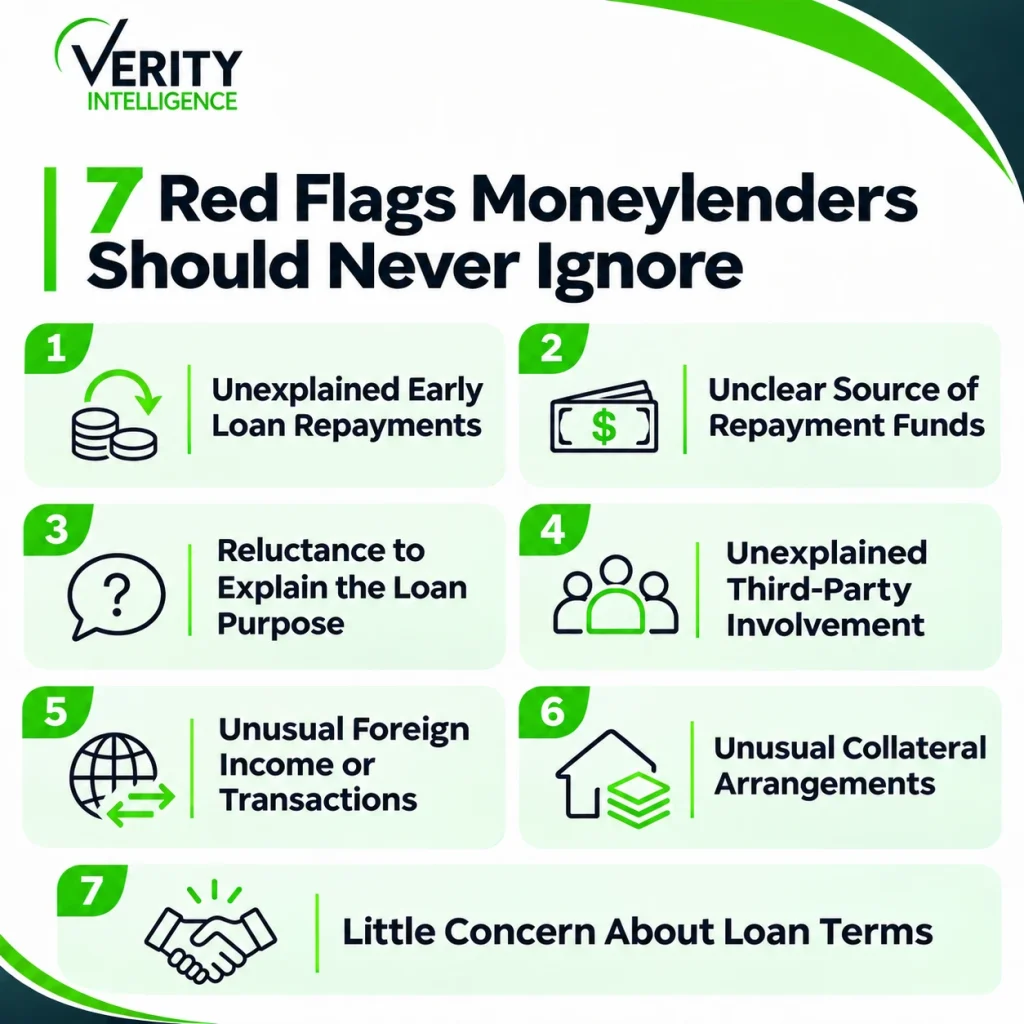
1. Unexplained Early Loan Repayments
Early repayment is generally positive from a credit perspective.
However, a borrower who unexpectedly settles a long-term loan shortly after receiving financing may raise questions if the source of repayment is unclear.
For example, a borrower with modest declared income may suddenly repay a substantial outstanding amount without a reasonable explanation.
Moneylenders should consider whether the repayment is consistent with the borrower’s known financial circumstances.
2. Unclear Source of Repayment Funds
A borrower may make large repayments using funds that do not appear consistent with their occupation, business activities or declared income.
This becomes particularly concerning when the borrower cannot reasonably explain where the money originated.
Understanding the source of funds, where required by the applicable risk assessment and regulatory framework, can help identify potential financial crime risks.
3. Reluctance to Explain the Loan Purpose
Borrowers should be able to provide a reasonable explanation for why financing is needed.
A customer who repeatedly changes their explanation, provides vague information or refuses to clarify the intended use of funds may warrant closer attention.
For example, an applicant may initially claim that financing is needed for business expansion but later provide conflicting information about the business.
Such inconsistencies should be assessed rather than automatically dismissed.
4. Unexplained Third-Party Involvement
A borrower may submit identification, employment or income documents through an intermediary who has no apparent reason to be involved.
Similarly, repayments made by unrelated third parties may require further clarification.
Third-party arrangements are not necessarily suspicious. However, moneylenders should understand the relationship between the borrower and any individual acting on their behalf.
5. Unusual Foreign Income or Transactions
A borrower may declare substantial income from overseas sources but provide limited information about the origin of those funds.
Cross-border financial arrangements can be legitimate. Nevertheless, unexplained foreign income or transactions involving higher-risk jurisdictions may justify additional due diligence.
The level of scrutiny should reflect the customer’s circumstances and assessed risks.
6. Unusual Collateral Arrangements
Some borrowers may offer valuable assets as collateral without being able to explain their ownership or origin.
For example, an applicant may seek financing secured against an asset that appears inconsistent with their known financial profile.
Moneylenders should consider whether additional verification is necessary to understand the collateral arrangement and the parties involved.
7. Little Concern About Loan Terms
Most borrowers consider interest rates, repayment schedules and borrowing costs before accepting financing.
A customer who appears unusually unconcerned about these terms may present a potential warning sign, particularly when combined with other suspicious circumstances.
This behavior alone does not establish wrongdoing. However, it may justify closer examination of the transaction’s purpose.
A red flag is not proof of financial crime. It is an indicator that may require further investigation or enhanced due diligence.
Why Credit Checks Alone May Not Be Enough
Credit checks are valuable tools for assessing financial reliability.
They can provide information about repayment history, outstanding obligations and other relevant credit indicators.
However, a favorable credit profile does not necessarily mean that a borrower presents no financial crime or integrity risks.
For example, a borrower with a satisfactory repayment record may still have relevant sanctions exposure or appear in adverse media.
This is why moneylenders should distinguish between two types of assessments:
| Assessment | Main Purpose |
|---|---|
| Credit Assessment | Evaluate repayment capacity and creditworthiness |
| Background Risk Screening | Identify relevant sanctions, watchlist, PEP, adverse media and other available risk indicators |
A comprehensive approach considers both financial information and relevant integrity risks.
Moneylenders can use VERISafe instant background screening to support the risk-screening component of borrower onboarding and review.
When Should Moneylenders Conduct Customer Risk Screening?
Customer risk screening is particularly useful when establishing a new lending relationship.
However, it should not necessarily stop once financing has been approved.
Borrower circumstances may change over time, and new information may become available.
Moneylenders should consider appropriate risk screening at several stages.
During borrower onboarding: Identify potential risk indicators before establishing the financing relationship.
When relevant customer information changes: Reassess risks when significant changes in identity, ownership, representation or other relevant details arise.
When suspicious repayment patterns emerge: Review unusual transactions or repayment behavior that appears inconsistent with the borrower’s known profile.
During ongoing due diligence: Conduct periodic or event-driven reviews according to applicable requirements and assessed risk levels.
This approach helps moneylenders maintain a more current understanding of their borrowers.
How Moneylenders Can Strengthen Their Customer Due Diligence Process
An effective CDD process should be structured, consistent and appropriate to the lender’s risk exposure.
Moneylenders can strengthen their procedures by focusing on several practical measures.
Verify Customer Information
Ensure that relevant identification details and supporting information are obtained and verified using appropriate sources.
Understand the Financing Purpose
Assess whether the requested financing and intended use of funds are consistent with the customer’s known circumstances.
Identify Relevant Parties
Understand who is applying for financing, who may be conducting transactions on the customer’s behalf and whether relevant beneficial owners or other parties require assessment.
Conduct Risk-Based Screening
Screen relevant parties against applicable sanctions and risk information sources, and review potential matches carefully.
Document and Review Findings
Maintain appropriate records of customer assessments, decisions and follow-up actions. Escalate suspicious findings through established internal procedures.
Where broader checks are needed for employees, business partners or other appropriate corporate screening purposes, Verity Intelligence’s comprehensive background check services provide additional verification options, subject to applicable consent and legal requirements.
These measures can help build a more consistent and defensible customer risk management process.
How VERISafe Supports Moneylender Background Checks
For moneylenders processing multiple applications, manually searching different risk information sources can be time-consuming.
VERISafe by Verity Intelligence is an instant screening solution designed to help businesses identify relevant risk indicators more efficiently.
Its screening sources include:
- Global and local sanctions lists
- Terrorism-related watchlists
- Politically exposed persons (PEPs)
- Adverse media
- Relevant Malaysian police postings and court records
By incorporating VERISafe into an appropriate screening workflow, moneylenders can identify potential concerns earlier and prioritize findings requiring closer examination.
Faster Risk Identification
Instant database screening can help reduce the time required for initial risk checks during borrower onboarding.
More Consistent Screening
A structured screening process helps lenders apply similar risk-screening procedures across relevant applications.
Support for Repeat Screening
Moneylenders can conduct repeat checks when required by their ongoing due diligence procedures.
Better-Informed Decisions
Potential risk indicators can be reviewed alongside other customer information before decisions are made.
For more information about the screening process and how potential matches are interpreted, visit ¨.
Importantly, VERISafe does not assess a borrower’s creditworthiness, verify all identity documents or independently fulfill every CDD obligation. It supports the risk-screening component of a broader compliance and lending assessment process.
Conclusion: Know Who You’re Lending To Before You Lend
For moneylenders in Malaysia, responsible lending is not only about evaluating repayment capacity. It also involves understanding borrowers, identifying relevant risks and recognizing suspicious activities that may require further attention.
Unexplained repayments, unclear funding sources, unusual collateral arrangements and undisclosed third parties are examples of warning signs that should not be overlooked.
By combining appropriate Customer Due Diligence procedures with risk-based background screening, moneylenders can strengthen their decision-making processes and reduce exposure to financial crime risks.
Before approving the next loan, ask yourself: Do you really know who you’re lending to?
Trust is important, but trust should be supported by verification.
Strengthen your borrower risk screening with VERISafe. Discover how Verity Intelligence can support your organization’s screening and risk management needs.